
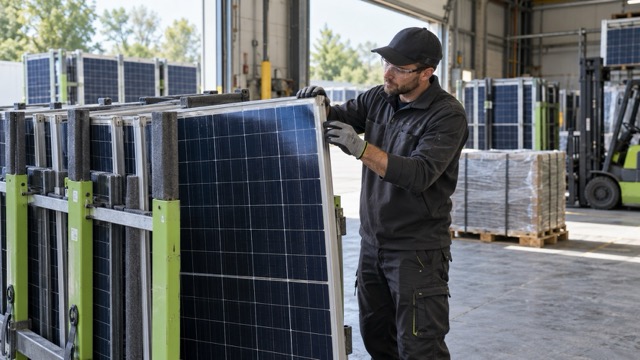
Plan the recovery of retired photovoltaic equipment before it leaves the project site. ecoTech helps organizations scope solar panel recycling and PV management around module type, condition, quantity, logistics and required documentation.
A defined route for retired solar equipment
Solar equipment can require recovery after repowering, replacement, installation damage or the end of its operating life. The condition of the modules and the circumstances of removal influence how the project should be handled.
We begin with a review of the equipment and proposed collection. That review helps establish acceptance, the appropriate processing route and the responsibilities for packing and transport. It also gives your facilities or project team an opportunity to identify related equipment that needs a different plan.
Information to gather about your PV modules
- Manufacturer, model and available technical information
- Module technology, where known, and approximate dimensions
- Quantity, estimated weight and number of locations
- Condition, including cracked glass or other damage
- Whether modules are installed, removed, packaged or stored loose
- Access conditions, loading arrangements and project deadlines
Photographs can help establish what requires further review. Discuss thin-film modules, mixed product types and damaged loads before arranging transportation. Acceptance and processing arrangements need to be confirmed for the specific material.
Account for classification and location
Discarded solar panels do not all have the same waste classification. The EPA’s guidance on end-of-life solar panels explains that some panels may be hazardous waste and that state requirements also matter. The generator’s classification responsibilities should be addressed before the shipment is arranged.
We use the available product information and confirmed project requirements to discuss a suitable recovery route. Tell us about any existing waste characterization or testing. Avoid assuming that a general electronics collection arrangement covers every type of PV module.
Coordinate modules and related equipment separately
A solar project may also generate inverters, monitoring devices, cables and other electrical equipment. Identify those items during scoping so they can be reviewed for the appropriate electronics recycling route.
Energy-storage batteries need a separate assessment through battery recycling and management. Large installed systems, electrical disconnection, roof work and structural removal require specifically assigned responsibilities. Recovery arrangements should be scheduled around the authorized removal team’s work.
For collections across several sites, reverse logistics can coordinate the movement of approved materials while preserving the project and location references needed for reporting.
Agree on the outcome records
Useful documentation may include collection records, counts or weights, material descriptions and processing documentation. Identify which records your asset owner, project manager or sustainability team needs before work begins.
Any statement about material recovery or environmental benefit should reflect the actual processing route and available evidence. Our reporting services can help organize those records without treating every collected pound as a verified recovered material.
Questions about solar panel recycling
Can broken solar panels be included?
They require advance review. Share photographs, product information and the extent of the damage so acceptance, packaging and handling requirements can be assessed before collection.
Does the service include removing panels from a roof or array?
Removal and electrical work must be explicitly addressed in the project scope. Do not assume that a recycling collection includes disconnection, roof access or structural work.
What determines the cost?
Module type and condition, quantity, location, packaging, loading and the confirmed processing route all affect cost. Accurate equipment details help identify those requirements before a quote is finalized.
Discuss your solar equipment project
Send ecoTech your module list and site details to begin an acceptance and logistics review.