
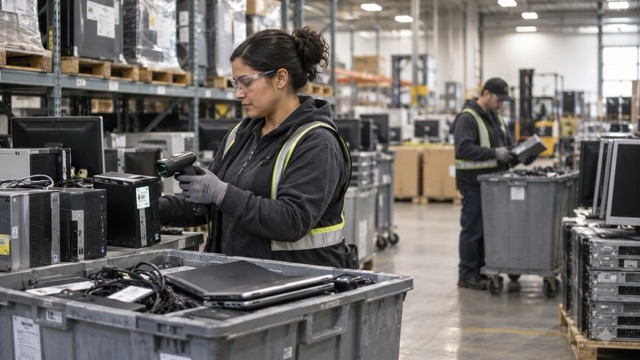
Electronics recycling, also called e-waste recycling, helps businesses and organizations manage retired devices through a documented recovery process. ecoTech coordinates equipment collection, data-security requirements and responsible recycling for cleanouts, technology refreshes and ongoing programs nationwide.
Electronics recycling that closes the loop on retired equipment
A storage room full of old computers often represents several unfinished jobs: equipment awaiting approval, devices that may still contain data and assets whose final destination needs to be documented. We help your team bring those jobs together in one coordinated project.
We start with the equipment mix, approximate volume, locations and access conditions. Your security requirements and reporting needs then shape the collection and processing plan. That gives IT, facilities and procurement a shared understanding of what will happen before equipment leaves the building.
Business E-Waste Pickup & Bulk Recycling
Coordinate a bulk equipment pickup for an office move, facility cleanout or technology refresh, or establish a recurring collection program for ongoing needs. We can also plan projects involving multiple locations. Collection arrangements depend on equipment type and volume, site access, location, labor and security requirements.
What electronics can be recycled?
Common business equipment includes:
- Desktop computers, laptops, workstations and related components
- Servers, storage systems, routers, switches and networking equipment
- Monitors and displays, including LCD and CRT equipment
- Printers, copiers, scanners and other office electronics
- Phones, mobile devices and telecommunications equipment
- Circuit boards, memory, processors, cables and power supplies
Send us an inventory or a few photographs when requesting a quote. Tell us about unusually large items, damaged equipment or embedded batteries so we can confirm acceptance and handling requirements. Batteries require their own review through our battery recycling and management service.
View the equipment we accept for additional categories and items that need advance review.
Protect data and identify equipment with remaining value
Equipment retirement should include an explicit decision about stored information. Our secure data and media destruction services address hard drives, solid-state drives and other media according to the agreed project requirements. Specify whether you need serial-number records, on-site destruction or another defined level of documentation before collection.
Working equipment may also warrant a closer look before it enters a recycling stream. Through IT asset disposition and value recovery, suitable assets can be evaluated for reuse or resale. Condition, specifications, data requirements and market demand determine whether recovery value is available. Equipment without a viable reuse route can move into responsible materials recovery.
What your organization receives
We agree on the deliverables at the start of the project. Depending on the scope, these can include collection records, equipment counts or weights, asset-level records, certificates for completed data destruction and recycling documentation.
If you need reports separated by location, department or collection date, tell us before work begins. Our sustainability and compliance reporting service helps connect those records to the people who need them.
For vendor evaluation, the EPA’s guidance on certified electronics recyclers explains the role of independent standards. Review our certifications and ask about the facility, services and certification scope that apply to your project.
ecoTech coordinates electronics recycling projects nationwide, with collection arrangements defined for each site. Explore our facilities and offices and contact our team about your project location.
Questions about business electronics recycling
What is the difference between electronics recycling and ITAD?
Electronics recycling focuses on recovering materials from equipment that has reached the end of its useful life. IT asset disposition (ITAD) also addresses data handling, asset evaluation, reuse, resale and reporting. A business retirement project may use both pathways depending on equipment condition and security requirements.
How much does an electronics recycling pickup cost?
Pricing depends on equipment type and quantity, collection location, labor and access requirements, transportation, data services and documentation. An inventory helps us quote the work accurately. Any potential recovery value should be considered alongside the cost of collecting and processing the equipment.
Can you help with a recurring program or several locations?
Yes. We can discuss a coordinated program for periodic refreshes or multiple facilities, with collection arrangements and reporting defined for each site. A reverse logistics plan can bring separate collections into a consistent process.
What should we do before a pickup?
Confirm that the equipment is approved for retirement, complete any required backups and identify assets subject to retention requirements. Keep items awaiting collection in an appropriate controlled area. We will agree on packing, access and handoff responsibilities with your team.
Plan your electronics recycling project
Tell us what you have, where it is located and when it needs to move. Request a project consultation to define the collection, security and reporting requirements.